
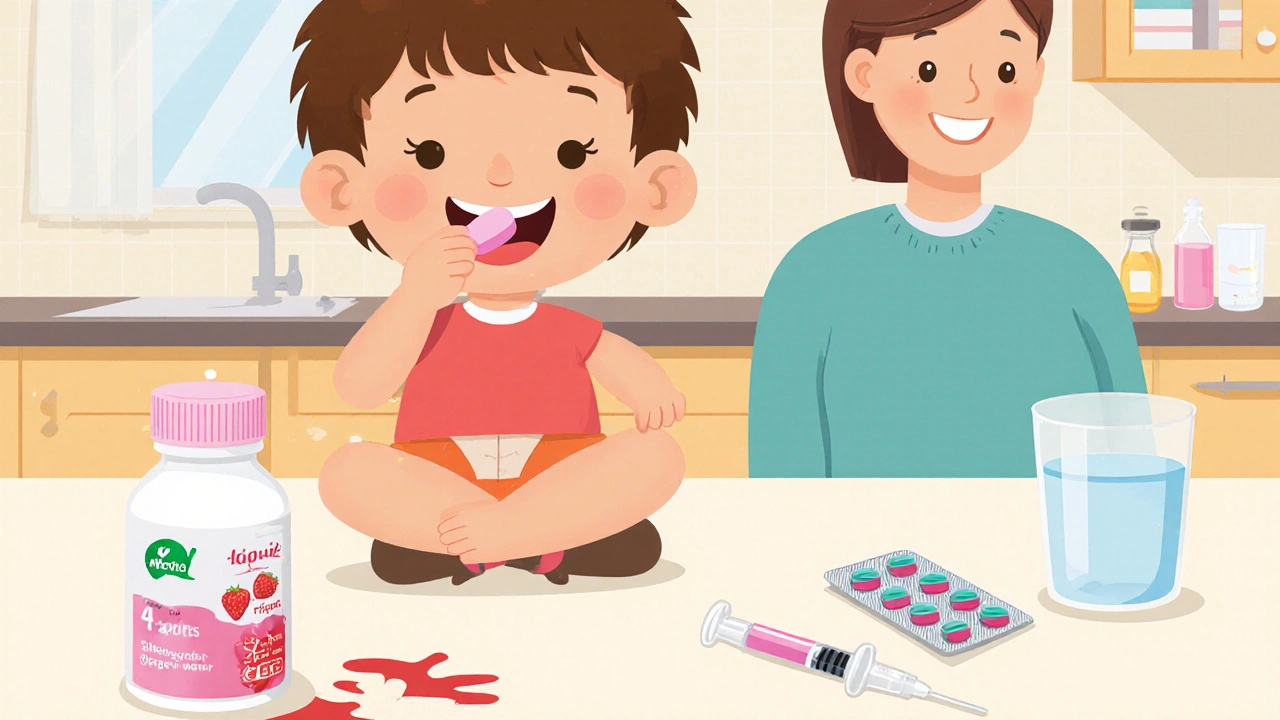
When your child is sick, the last thing you want is a battle over medicine. You’ve got a feverish toddler, a stubborn 5-year-old, and a bottle of liquid antibiotic that tastes like regret. Or maybe you’re staring at a tiny tablet, wondering if your kid can swallow it without choking. The choice between liquid and tablet medications for children isn’t just about convenience-it’s about safety, accuracy, cost, and long-term health habits.
Why Liquids Have Been the Default
For decades, doctors and parents assumed kids couldn’t swallow pills. It made sense: infants can’t chew, toddlers spit out anything bitter, and measuring drops seemed safer than guessing a tablet size. Liquid medications became the default. But that’s changing. Today, research shows that up to two-thirds of liquid prescriptions for children could be replaced with solid forms-without losing effectiveness. The European Medicines Agency started pushing this shift back in 2013, recommending kids as young as 3 be trained to swallow pills. Why? Because liquids aren’t as simple as they seem. Many require refrigeration, spoil within weeks after opening, and often taste awful-even when labeled "strawberry flavored." A 2007 study found 68% of kids refuse liquid meds because of bad taste. And here’s the kicker: parents mess up dosing 15-20% of the time. A spilled spoon, a misread syringe, a rushed pour-it adds up.Tablets Aren’t What You Think Anymore
If you picture a big, hard pill, you’re thinking of adult medicine. Pediatric tablets today are nothing like that. Mini-tablets as small as 2mm wide-smaller than a grain of rice-are now common. They’re coated to hide bitter tastes, designed to dissolve in seconds, and come in flavors kids actually recognize: real strawberry, bubblegum, even chocolate. A 2012 study tracked 60 kids aged 6 months to 6 years. Those given mini-tablets swallowed them just as easily as liquids-even babies under 1 year. And in kids who refused liquids, tablet acceptance was 25% higher. Why? Because kids aren’t scared of swallowing-they’re scared of the taste. A tablet that doesn’t taste like chemicals? That’s a game-changer. Modern orodispersible tablets dissolve on the tongue with no water. Film-coated mini-tablets don’t need to be crushed. And crushing? That’s the real danger. When you crush a time-release tablet, you risk giving your child a full dose all at once. It’s happened. And it’s dangerous.Accuracy: The Hidden Advantage of Tablets
Liquid dosing sounds precise-but it’s not. The FDA found that 12-18% of liquid doses are wrong because of measurement errors. A parent uses a kitchen spoon because the syringe is lost. Or they eyeball it. Or the bottle leaks. Even a 10% overdose can cause side effects in small children. Tablets? One pill = one exact dose. No measuring. No spills. No guessing. For antibiotics, pain relievers, or allergy meds with wide therapeutic windows, this accuracy matters more than you think. A 2018 study showed solid forms cost 25-40% less per dose. For families paying out-of-pocket, or hospitals managing thousands of prescriptions, that adds up fast. In the UK, switching just 10,000 pediatric liquid prescriptions to tablets saved £7,842. For a hospital, that’s tens of thousands a year.When Liquids Still Win
This isn’t a blanket rule. Liquids still have their place. For babies under 6 months, swallowing pills isn’t possible. For medications that need fine-tuned dosing-like levothyroxine for thyroid issues or warfarin for blood thinning-liquid allows micro-adjustments based on weight. You can give 0.3mL, not 1 tablet that’s too strong. Also, if your child has a swallowing disorder, severe reflux, or is on a feeding tube, liquid is safer. But for most healthy kids? The evidence leans hard toward solids.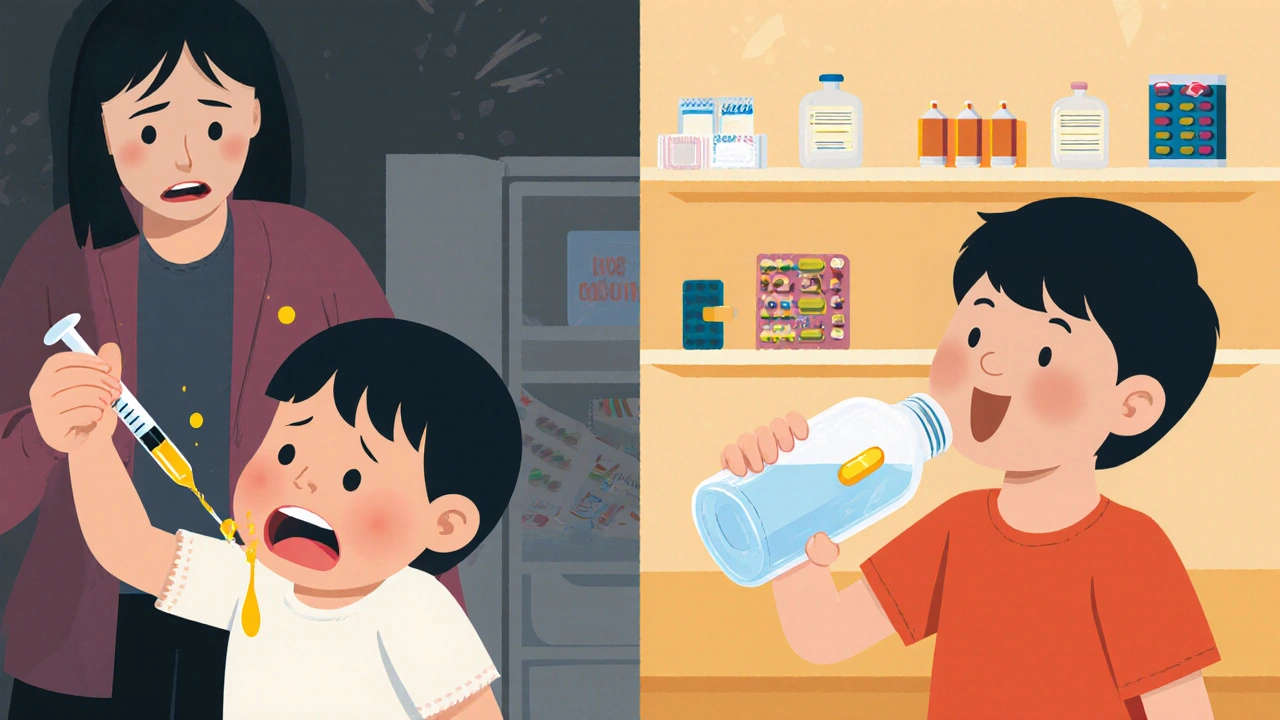
How to Train Your Child to Swallow Tablets
The biggest barrier isn’t the tablet-it’s the fear. Parents worry about choking. But choking incidents with properly sized pediatric tablets are extremely rare-less than 0.002% of cases, according to FDA data. Start training around age 3. Use practice techniques:- Start with mini-marshmallows or tiny bread balls-same size as the tablet.
- Have your child sit upright, take a sip of water, then place the pill on the tongue.
- Use the "pop-bottle method": Place the tablet on the tongue, close lips around a water bottle, and suck. The water flow helps push the pill down.
- Practice daily for 5 minutes. Celebrate small wins.
Cost, Storage, and Shelf Life
Liquid meds often come in big bottles. Once opened, they’re good for only 14-30 days. Many need refrigeration. If you forget to chill it, the medicine degrades. You throw half away. You pay again next month. Tablets? They last 2-3 years at room temperature. No fridge. No expiration anxiety. No wasted medicine. A single blister pack of mini-tablets lasts longer than a bottle of liquid-and costs less per dose. In Australia, where you might be paying for prescriptions under the PBS, this matters. Even small savings add up across a family’s yearly meds.What Doctors Aren’t Telling You
A 2021 survey of 500 US pediatricians found 62% still automatically prescribe liquids for kids under 8-even though the evidence says otherwise. Why? Parental preference. Fear of complaints. Lack of training. Only 18% of pediatricians feel confident teaching parents how to help kids swallow tablets. That’s a gap. You’re not being told the truth because your doctor doesn’t know the latest data. Don’t assume liquid is safer. Ask: "Is there a tablet form? Can we try it?"Real Parent Stories
On parenting forums, the feedback is loud: > "My 4-year-old would rather swallow a mini-tablet than take the ‘strawberry’ antibiotic. It tasted like plastic and chemicals. The tablet? Tasted like candy. No fight. No mess. No tears." > "We switched from liquid amoxicillin to mini-tablets. We used the bottle trick. Within a week, she was swallowing them like popcorn." > "I used to dread giving meds. Now I keep a small pill case in my purse. One tablet, one sip of water. Done." The emotional toll of medicating a resistant child is real. Tablets reduce stress-for everyone.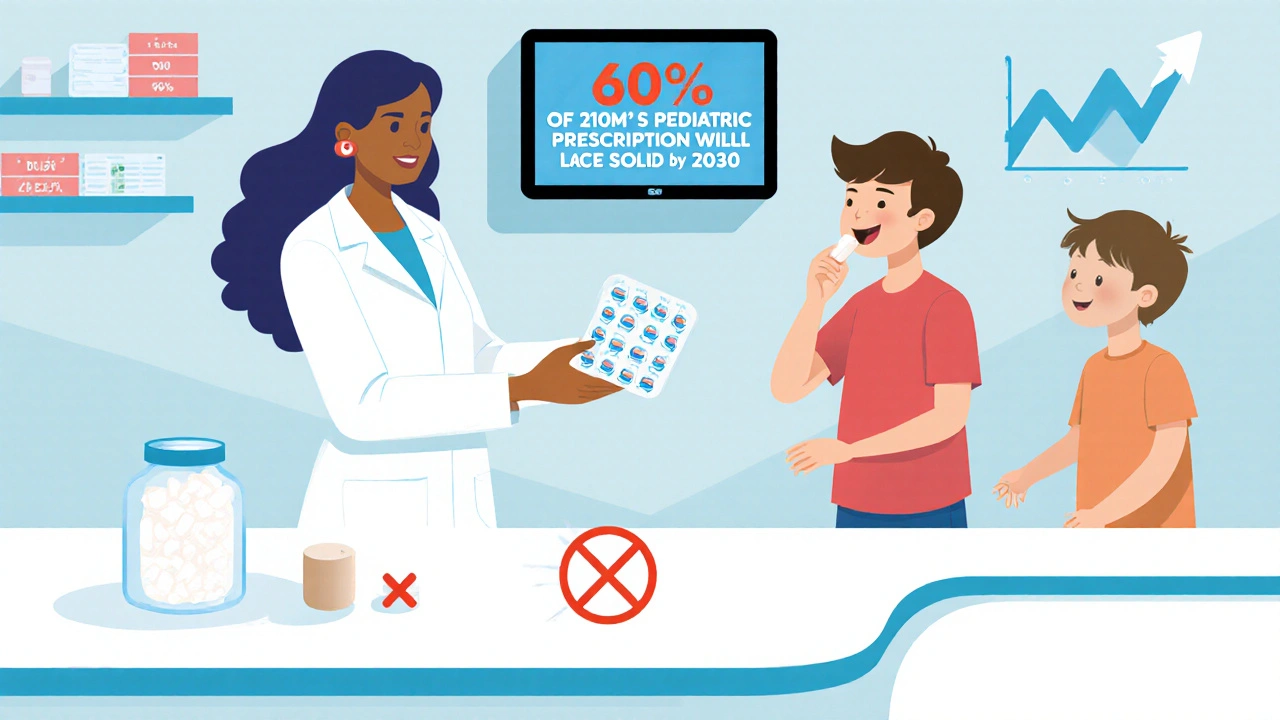
What to Ask Your Pharmacist
When you get a prescription:- "Is there a tablet or mini-tablet version of this?"
- "What size is it? Can I see it?"
- "Does it need refrigeration?"
- "Is it flavored with real fruit or artificial taste?"
- "Can you show me how to help my child swallow it?"
The Future Is Solid
The global market for pediatric medications is growing fast. But the direction is clear: more tablets, fewer liquids. The FDA and WHO now encourage solid forms for kids as young as 2. New micro-tablets, just 1mm wide, are being tested-so small they can be sprinkled on food or swallowed whole. By 2030, solid forms could make up 60% of pediatric prescriptions. That’s not a guess-it’s a projection based on adherence rates. Kids who take their meds correctly? They heal faster. They miss less school. Their parents lose less sleep.Final Decision Guide
Here’s how to choose:- Choose tablets if: Your child is over 2 years old, the medication doesn’t need precise weight-based dosing, and you want less waste, better taste, and easier storage.
- Stick with liquid if: Your child is under 6 months, the drug requires exact titration (like thyroid or blood thinners), or they have a swallowing disorder.
Can a 2-year-old swallow a tablet?
Yes, many 2-year-olds can swallow appropriately sized mini-tablets with proper training. Start with practice using small, soft foods like mini-marshmallows. Use the "pop-bottle method"-place the tablet on the tongue, then sip water from a bottle. Studies show over 90% of children aged 3 and up can succeed with coaching. For 2-year-olds, success depends on individual development, but it’s increasingly common and safe.
Are liquid medications more accurate than tablets?
Not necessarily. While liquids allow for fine-tuned dosing, parents often mismeasure them-up to 20% of the time, according to the American Academy of Pediatrics. Tablets deliver one exact dose every time. For most medications, especially antibiotics and pain relievers, tablet accuracy is higher because there’s no risk of spilled liquid or incorrect syringe readings.
Why do some kids refuse liquid medicine?
Taste is the biggest reason. Many "flavored" liquids don’t taste like real fruit-they’re chemically sweetened and bitter underneath. A 2007 study found 68% of children refuse liquid meds because of unpleasant taste. Tablets can be coated to mask bitterness and come in real fruit flavors, making them far more acceptable to kids.
Is it safe to crush a tablet for my child?
No, never crush a tablet unless your doctor or pharmacist says it’s safe. Crushing can destroy time-release coatings, change how the drug is absorbed, or make it unsafe. For example, crushing a long-acting antibiotic could cause a dangerous overdose. Always ask for an age-appropriate formulation instead.
Do pediatric tablets cost more than liquids?
No, they usually cost less. A 2018 study showed solid forms are 25-40% cheaper per dose. Liquids require more packaging, refrigeration, preservatives, and flavoring-adding to the cost. Plus, you often waste half a bottle. Tablets come in blister packs with no spoilage risk. Over time, switching to tablets saves money for families and healthcare systems.
What if my child chokes on a tablet?
Choking on properly sized pediatric tablets is extremely rare-less than 0.002% of cases according to FDA data from 2010-2020. The real risk comes from giving adult-sized pills or crushing tablets. Always use age-appropriate mini-tablets and supervise swallowing. Teach your child to sit upright and drink water after taking the pill. If you’re worried, start with practice using soft foods before trying actual medication.


Post A Comment