
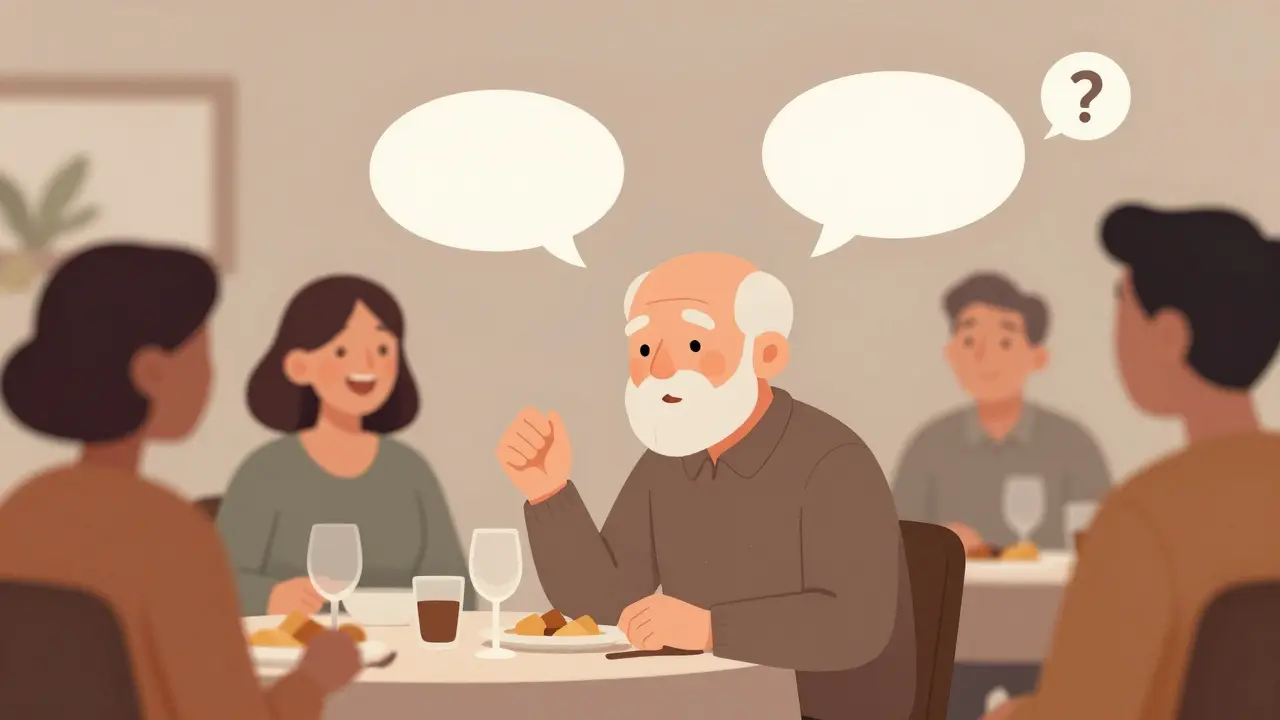
By the time you turn 65, there’s a one-in-three chance you’re already struggling to hear clearly. Not because you’re not trying, but because your ears are changing - slowly, silently, and without warning. This isn’t just about turning up the TV. It’s about missing your grandchild’s first words, avoiding family dinners because you’re tired of pretending you heard everything, or nearly missing a fire alarm in the middle of the night. This is presbycusis - the medical term for age-related hearing loss - and it’s more common than diabetes or arthritis in older adults.
What Exactly Is Presbycusis?
Presbycusis (pronounced prez-buh-KYOO-sis) isn’t just "getting older." It’s a specific type of hearing loss caused by damage to the tiny hair cells in your inner ear. These cells pick up sound vibrations and turn them into signals your brain understands. You’re born with about 16,000 of them. Once they’re gone, they don’t come back. And they start fading after age 30 - about 1% per year. By 70, many people have lost 40% or more.
This isn’t sudden. It creeps in. First, you notice you can’t hear birds chirping or children’s voices. Then, you start asking people to repeat themselves, especially in noisy rooms. High-pitched sounds like "s," "th," and "f" become muffled. Conversations turn into guessing games. You crank the TV volume past 65 decibels - louder than normal speech - just to catch the dialogue.
The National Institute on Deafness and Other Communication Disorders (NIDCD) reports that nearly half of Americans over 75 have significant hearing loss. That’s not normal aging. It’s a medical condition with real consequences.
Why It’s More Than Just "Can’t Hear Well"
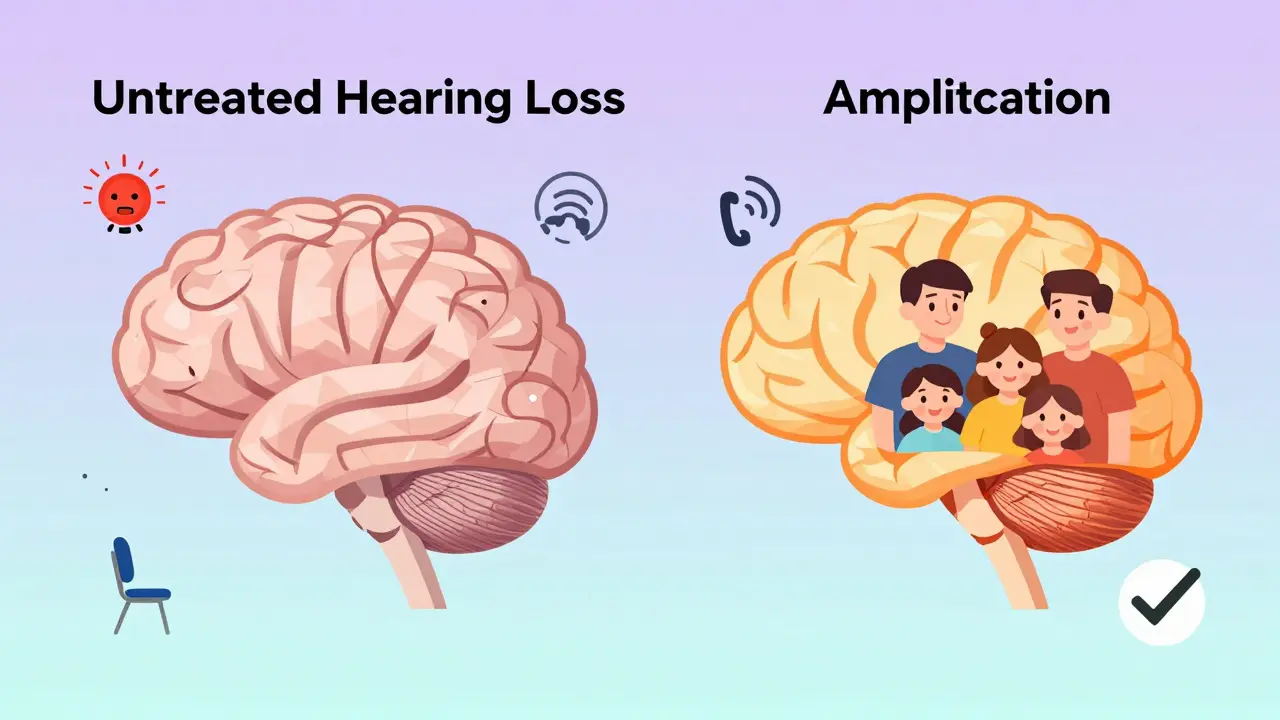
Untreated presbycusis doesn’t just make life harder - it makes it riskier. A 2020 Lancet Commission study found that people with unaddressed hearing loss have a 50% higher chance of developing dementia. Why? Because when your brain struggles to process sound, it overworks other areas, draining energy that should go to memory and thinking. It’s like running a car on empty - eventually, the engine fails.
Social isolation follows fast. Forty-one percent of older adults with hearing loss avoid gatherings because they’re embarrassed or exhausted from trying to keep up. Depression rates jump by 32% in this group, according to a 2022 JAMA Otolaryngology analysis of 36,000 people. And it’s not just emotional. A 2021 Better Hearing Institute study showed untreated hearing loss leads to an average $30,000 annual income drop - not because people lose jobs, but because they miss cues in meetings, misunderstand instructions, or withdraw from networking.
Even safety is at stake. One in three people with untreated hearing loss report failing to hear critical alarms - fire, car horns, or doorbells. That’s not a minor inconvenience. That’s a life-threatening gap.
What Causes It? It’s Not Just Age
Yes, aging is the main driver. But it’s not the only one. Genetics play a role in 35-50% of cases. If your parents or grandparents had hearing loss, you’re more likely to too. Genes like GRHL2 and GJB2 have been linked to faster decline.
But environment matters just as much. Years of loud noise - construction, concerts, power tools, even headphones turned up too high - can accelerate damage. The World Health Organization says exposure to sounds above 85 decibels for more than 8 hours a day increases your risk by 40%.
Other health problems make it worse. Diabetes raises the risk by 28%. High blood pressure by 23%. Smoking by 15%. These conditions reduce blood flow to the inner ear, starving the hair cells of oxygen. Even a single ear infection or head injury can leave lasting damage.
And here’s the kicker: most people don’t realize they’re losing their hearing until it’s already advanced. That’s because the brain adapts. It fills in gaps. You start nodding along, guessing words, avoiding tricky situations. By the time you go to the doctor, you’ve been struggling for years.
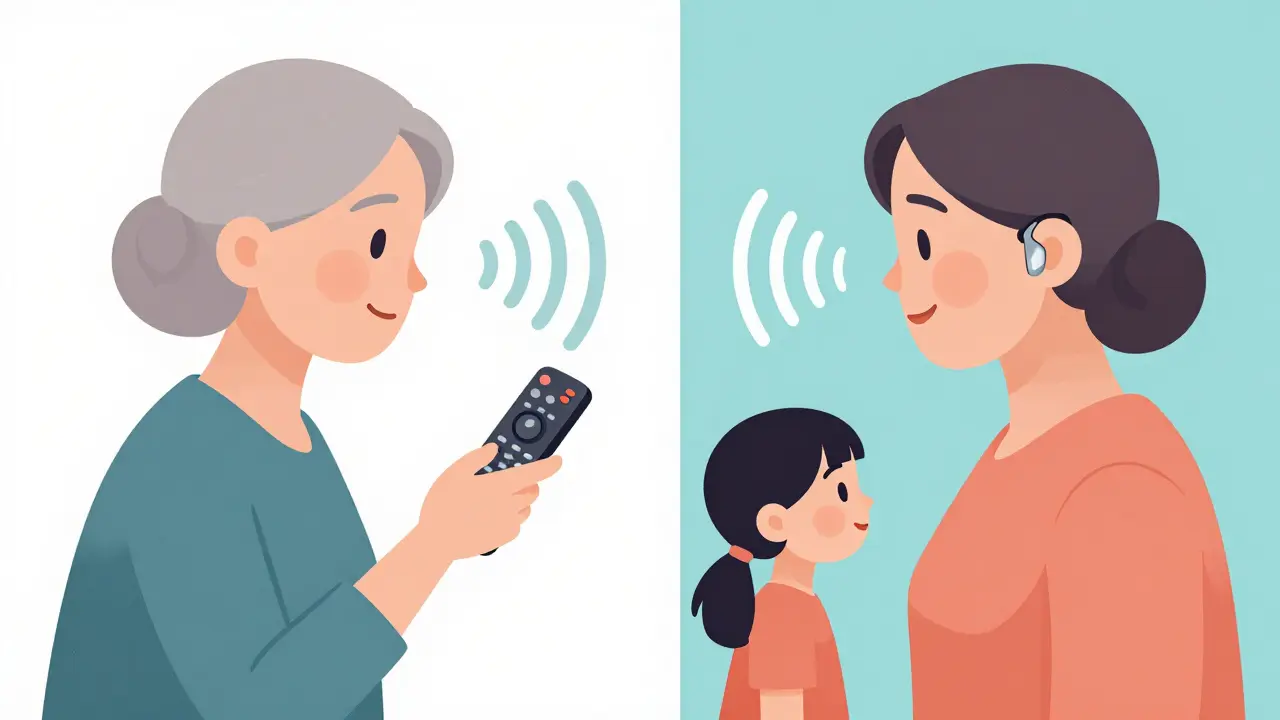
Amplification Isn’t Just Hearing Aids - It’s a System
There’s no cure for presbycusis. But there is a solution: amplification. And it’s not just about buying a hearing aid and wearing it.
Modern hearing aids are tiny computers. They don’t just make everything louder. They use 16 to 64 frequency channels to selectively boost speech sounds while reducing background noise. Directional microphones improve your ability to hear someone across the table in a restaurant by 3 to 6 decibels. Bluetooth lets you stream calls or TV audio straight to your ears.
Prescription devices from brands like Phonak, Oticon, and Signia cost between $1,800 and $3,500 per ear. They’re custom-fit, professionally programmed, and backed by regular check-ups. But they’re not the only option anymore.
Since the FDA approved over-the-counter (OTC) hearing aids in 2022, prices have dropped. You can now get decent devices for $200-$1,000. Brands like Jabra Enhance Select and Eargo are popular. Consumer Reports rates Jabra at 78/100 - not as good as premium models, but good enough for mild to moderate loss.
Still, only 30% of people who could benefit from hearing aids actually use them. Why? Because many don’t get fitted right. Forty-five percent of users quit within six months because the device doesn’t fit well, causes discomfort, or doesn’t help in noisy places. It’s not the technology’s fault - it’s the lack of support.
Getting Started: What Actually Works
Don’t just walk into a store and pick up a box. Here’s what you need to do:
- Get a hearing test. See an audiologist - not a hearing aid dispenser. They’ll measure your hearing range, speech clarity, and noise tolerance. A baseline test at age 50 is recommended.
- Try before you buy. Most clinics offer 30-60 day trials. Test the device in real life - at home, in traffic, at the grocery store.
- Expect a learning curve. It takes 4-6 weeks for your brain to adjust. At first, everything will sound too loud or tinny. That’s normal. Your brain is relearning how to hear.
- Get professional fitting. A custom ear mold or proper shell fit is critical. Thirty percent of users need this. Poor fit means feedback, poor sound, and early abandonment.
- Use remote tuning. Many clinics now offer app-based adjustments. You don’t need to drive across town for a tweak. Sixty-two percent of audiology practices now offer this.
Rechargeable models are becoming standard. They last 16-20 hours per charge and eliminate the hassle of tiny batteries. Most users replace batteries every 3-14 days - but rechargeables cut that to once every two days.
What Users Really Say
On Reddit’s r/HearingAids, one user, "HearingHopeful42," wrote: "After 15 years of pretending I heard my granddaughter, my Phonak Audeo M-312s let me hear her laugh again. I cried the first time."
But others aren’t so lucky. Thirty-eight percent report wind noise as unbearable. Twenty-seven percent struggle with Bluetooth pairing. Forty-two percent say restaurants are still too hard to handle.
Top-rated prescription models? Widex Moment (87/100) and Oticon More (85/100). For OTC? Jabra Enhance Select leads at 78/100. Cost is still a barrier - 68% of users pay over $2,000 out-of-pocket. But Medicare Advantage plans now cover hearing aids for 28 million people as of 2024. That’s a big shift.
What Experts Are Saying
Dr. Frank R. Lin from Johns Hopkins says treating hearing loss at 60 instead of 70 could cut dementia risk by 8-10% over a decade. That’s not a small win. That’s life-changing.
Dr. Gayla Poling at Mayo Clinic says modern hearing aids achieve 90% user satisfaction - when properly fitted. But Dr. Barbara Weinstein points out the gap: only 15% of primary care doctors screen for hearing loss, even though guidelines say they should.
The message is clear: early action saves more than your hearing. It saves your brain, your relationships, your independence.
What’s Next for Hearing Technology
The global hearing aid market hit $9.3 billion in 2023 and is expected to grow to $14.7 billion by 2030. AI is making waves. Signia’s Nx platform reduces listening effort by 20%. ReSound’s LiNX Quattro tracks your steps and social interactions - turning hearing aids into health monitors.
Apps like Beltone’s SoundClear let you test your hearing at home. Over 1.2 million people have used it. It’s not a replacement for a professional test, but it’s a wake-up call.
The World Health Organization warns that without action, 1.5 billion people will have hearing loss by 2050. That’s nearly one in four people on Earth. Amplification isn’t a luxury anymore. It’s public health.
Final Thoughts: It’s Never Too Late
You don’t need to be perfect. You don’t need the most expensive device. You just need to act. If you’re asking people to repeat themselves, turning up the TV too loud, or avoiding conversations - it’s time.
Get tested. Try a device. Give yourself time. Talk to an audiologist. Don’t wait until you’re isolated, anxious, or at risk of falling behind in your health care. Your brain is still capable of learning to hear again. And the technology is better than ever.
Healing your hearing isn’t about fixing a broken ear. It’s about reconnecting with the people and moments that make life worth living.
Is presbycusis the same as general hearing loss?
No. Presbycusis is a specific type of hearing loss caused by aging, primarily affecting high-frequency sounds due to inner ear hair cell damage. General hearing loss can come from many causes - noise exposure, infections, medications, or earwax buildup. Presbycusis is progressive, permanent, and bilateral (affects both ears equally).
Can hearing aids restore normal hearing?
No, they can’t restore hearing to what it was at age 20. But they can improve speech understanding by 40-60% in quiet settings and 25-40% in noisy ones. Most users report being able to follow conversations again, enjoy TV, and reconnect with family. The goal isn’t perfection - it’s participation.
Are over-the-counter (OTC) hearing aids good enough?
For mild to moderate hearing loss, yes. OTC devices are regulated by the FDA and use similar technology to prescription aids - just with fewer custom settings. They’re ideal if you’re unsure about your hearing level or on a budget. But if you have trouble understanding speech, have tinnitus, or hear differently in each ear, see an audiologist first. OTC aids aren’t designed for complex cases.
Why do some people stop using hearing aids?
The top reasons are poor fit (45%), discomfort (30%), and not hearing well in noisy places (25%). Many users expect instant results. But it takes weeks for the brain to adjust. Also, skipping professional fitting and follow-ups is the biggest mistake. A $200 device with no tuning won’t help much. A $3,000 device with proper programming can change your life.
How often should I get my hearing checked?
Start at age 50. Get a baseline test. Then every two years after that. If you notice changes - like needing the TV louder, missing words, or ringing in your ears - get tested sooner. Hearing loss progresses slowly, but catching it early makes amplification far more effective.
Does Medicare cover hearing aids?
Original Medicare (Parts A and B) does not cover hearing aids. But many Medicare Advantage plans (Part C) now include hearing benefits. As of 2024, 28 million beneficiaries have coverage for hearing aids through these plans. Check your plan details - you may be eligible for partial or full coverage.
Can hearing loss affect mental health?
Yes, strongly. Untreated hearing loss increases the risk of depression by 32%, social isolation by 5.3 times, and cognitive decline by up to 50%. When you can’t follow conversations, you withdraw. That loneliness rewires your brain. Treating hearing loss doesn’t just improve sound - it improves mood, connection, and brain health.


Post A Comment