
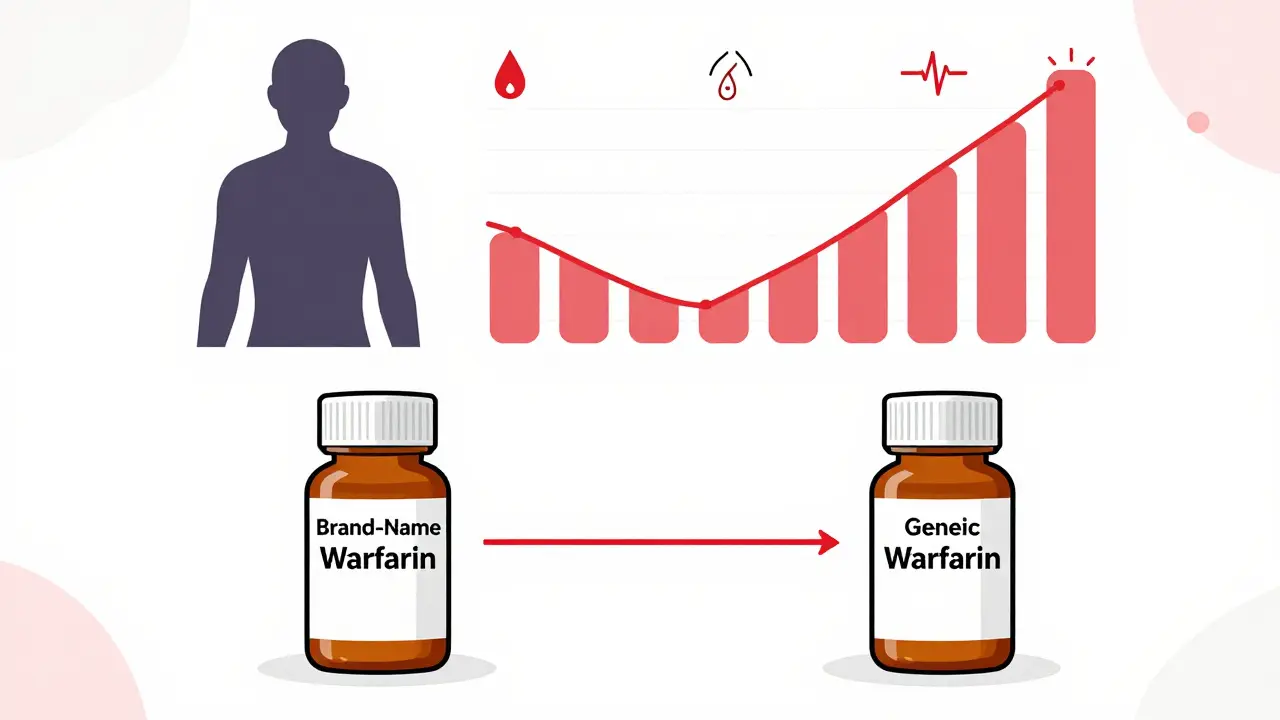
When a patient switches from a brand-name drug to a generic version, most people assume it’s a simple swap - same active ingredient, same effect. But for NTI generics, that assumption can be dangerous. Narrow Therapeutic Index drugs have a razor-thin line between a dose that works and one that causes harm. A 5% variation in blood concentration might mean the difference between controlling seizures and triggering a seizure, or keeping blood thinning at safe levels and causing internal bleeding. This isn’t theoretical - real patients have experienced dangerous fluctuations after switching generics. So how do different countries handle this? The answer isn’t the same anywhere in the world.
What Makes NTI Drugs Different?
NTI drugs aren’t just any generic medication. They’re the ones where tiny changes in how the body absorbs or processes the drug can lead to serious consequences. The FDA defines them as medications where small differences in dose or blood concentration may lead to serious therapeutic failures or adverse reactions. Common examples include warfarin (a blood thinner), phenytoin (for seizures), digoxin (for heart failure), and levothyroxine (for thyroid conditions). These aren’t obscure drugs - millions take them daily. But their safety depends on extreme precision. A generic version that’s 92% bioequivalent might be fine for an antibiotic. For warfarin? That’s a red flag.
The regulatory challenge? Proving that a generic version behaves exactly like the brand-name drug in real human bodies. That’s not easy. Standard bioequivalence tests - which usually allow a range of 80% to 125% in drug absorption - are too loose for NTI drugs. If a patient’s blood levels swing outside that narrow window, even by a few percentage points, outcomes can go sideways. That’s why regulators had to rethink their rules.
The U.S. Approach: Tighter Limits, More Oversight
The U.S. Food and Drug Administration (FDA) took a hard line starting in 2010. For NTI drugs, they tightened two key standards: quality assay and bioequivalence limits. For quality, the acceptable range for active ingredient content dropped from 90-110% (used for regular generics) to 95-105%. For bioequivalence, the acceptance range was also tightened - sometimes to 80-125%, but often even tighter depending on the drug. In some cases, the FDA requires reference-scaled average bioequivalence (RSABE), which adjusts the range based on how variable the original drug is in patients.
It’s not just about lab numbers. The FDA also requires more rigorous testing. Studies must use healthy volunteers - not patients - to remove confounding factors like disease state or other medications. And they demand multi-point dissolution profiles, meaning the drug’s release over time is measured at multiple intervals, not just one or two. Since 2023, the Generic Drug User Fee Amendments (GDUFA) III added mandatory post-marketing surveillance for NTI generics. That means companies must track real-world outcomes after approval, not just rely on pre-market trials.
But even with strict rules, problems persist. Twenty-six U.S. states have special laws around NTI substitution. North Carolina requires written consent from both doctor and patient before switching. Connecticut, Idaho, and Illinois demand extra notifications for anti-epileptic drugs. Pharmacists report that 67% of them get calls from doctors asking them not to substitute generics for NTI drugs - especially for levothyroxine and warfarin. A Reddit thread from March 2023 had a pharmacist share three cases where patients had abnormal thyroid levels after switching generics - even though the FDA deemed them equivalent.
Europe’s Fragmented System
In Europe, the regulatory landscape is a patchwork. The European Medicines Agency (EMA) offers three pathways: the Centralized Procedure (CP), National Procedure (NP), and Mutual Recognition. The CP is voluntary for most generics but is becoming more popular - 68% of new generic applications in 2022 used it, up from 42% in 2018. It’s faster, taking about 210 days, and results in approval across all EU member states. But many companies still use the NP, which can take 12-18 months and varies by country.
Unlike the U.S., the EMA doesn’t have a single, unified bioequivalence limit for NTI drugs. Instead, they use a case-by-case approach. For some drugs, they accept the standard 80-125% range. For others - especially those with high variability - they allow scaled limits similar to the FDA. The key difference? European regulators focus more on clinical outcome data. If a drug has a long history of safe use in the market, they’re more willing to approve it based on real-world evidence, not just lab tests.
Price controls add another layer. In 24 of 27 EU countries, governments cap generic prices. In Spain, the first generic must be priced at least 40% lower than the brand. Subsequent generics must match or undercut that. This drives competition but also creates pressure to cut corners. A 2022 survey by the European Association of Hospital Pharmacists found that 58% of pharmacists were confused about substitution rules across different EU countries - especially when a generic was approved under the Decentralized Procedure in one country but not another.
Canada and Japan: Pragmatic but Precise
Health Canada takes a flexible but strict approach. They allow foreign-sourced reference products for bioequivalence studies - meaning a Canadian company can compare its generic to the U.S. or EU version of the brand drug, as long as it proves identical formulation, solubility, and dissolution profile. This saves time and money, but only if the data is rock-solid. Canada also requires multi-point dissolution testing and has published specific guidance for complex formulations like modified-release tablets.
Japan’s Pharmaceuticals and Medical Devices Agency (PMDA) is known for its detailed, technical guidance. They’ve issued over 100 drug-specific documents for topical products alone since 2007. For NTI drugs, they demand the same level of precision as the FDA, with tight bioequivalence limits and extensive stability testing. Their approval process is slower - often 18-24 months - but their rejection rate is lower because companies get clear direction early on. PMDA also encourages early meetings with regulators, which helps avoid costly mistakes later.
The Global Patchwork and the Push for Harmony
The big problem? Inconsistency. Only four major markets - the U.S., EMA, Canada, and Japan - have detailed, published guidance for NTI generics. Countries like Brazil, Mexico, Singapore, and South Korea have little to no specific rules. That creates risks. A generic approved in one country might be rejected in another. Patients traveling or receiving imported meds could be exposed to products that don’t meet the same safety standards.
The International Generic Drug Regulators Pilot (IGDRP), launched in 2012, includes regulators from the U.S., EU, Canada, Japan, and others. Their goal? Harmonize standards. Progress has been slow, but there are signs of movement. The ICH M9 guideline on biowaivers, adopted in 2023, could simplify testing for some NTI drugs. The FDA is planning to adopt population bioequivalence methods by 2025 - a more sophisticated way to measure how a drug behaves across diverse patient groups. Experts believe this will reduce approval times by 25-30% over the next decade.
Why This Matters to Patients
Behind every regulation is a person. A 72-year-old on warfarin. A teenager with epilepsy. A post-heart attack patient on digoxin. For them, switching generics isn’t a cost-saving convenience - it’s a gamble. A 2021 study from the IMS Institute tracked 12,500 patients across 15 European countries who switched to approved NTI generics. The results? 94.7% had the same clinical outcomes as before. That’s reassuring. But the other 5.3%? That’s 663 people who had unexpected side effects or treatment failures.
Manufacturers face huge costs too. Developing an NTI generic takes 18-24 months and $5-7 million - double the cost of a regular generic. That’s why only a few big players dominate the market: Teva, Mylan, Sandoz, and Hikma control over 40% of global NTI generics. Smaller companies often can’t afford the testing. That limits competition - and keeps prices higher than they could be.
The Road Ahead
The future of NTI generics hinges on two things: better science and better cooperation. Regulators need to agree on what “equivalent” really means. Should it be based on blood levels? Clinical outcomes? Both? The FDA’s shift toward population bioequivalence and the EMA’s move toward centralized approval are steps in the right direction. But without global alignment, patients will continue to face unpredictable risks.
For now, the safest approach is clear: if you’re on an NTI drug, don’t assume all generics are the same. Talk to your doctor. Ask your pharmacist. Know your country’s rules. And if you notice changes in how you feel after a switch - don’t ignore it. That tiny difference in dose? It might be more than just a number.
What drugs are considered NTI generics?
NTI generics include drugs where small changes in dose can cause serious harm or treatment failure. Common examples are warfarin (blood thinner), phenytoin (anti-seizure), digoxin (heart medication), levothyroxine (thyroid hormone), and cyclosporine (immunosuppressant). These drugs have a very narrow window between an effective dose and a toxic one. Even a 5-10% variation in blood concentration can lead to dangerous outcomes like bleeding, seizures, or organ rejection.
Why are bioequivalence limits tighter for NTI generics?
Standard bioequivalence limits (80-125%) are too wide for NTI drugs. For most medications, a 25% difference in absorption is acceptable because the body can handle it without harm. But for NTI drugs, that same difference could push a patient into a toxic range or below the therapeutic threshold. That’s why regulators like the FDA and EMA tighten the range - sometimes to 90-110% or even narrower - to ensure the generic behaves almost identically to the brand in real patients.
Can I safely switch between NTI generics?
It depends. In countries with strict regulatory standards - like the U.S., EU, Canada, and Japan - approved NTI generics are generally safe to switch. But some patients are more sensitive than others. If you’ve had stable results on one generic, switching to another - even if it’s FDA-approved - can cause fluctuations. Always monitor your lab results after a switch, and report any symptoms like dizziness, fatigue, or unusual bleeding to your doctor. Some states and countries require doctor approval before substitution.
Why do some doctors refuse to allow generic substitution for NTI drugs?
Doctors are cautious because of real-world reports of adverse events. A 2019 survey found that 67% of U.S. pharmacists received requests from physicians to avoid substituting generics for NTI drugs. Levothyroxine and warfarin were the top two concerns. Even when generics meet regulatory standards, individual patient responses vary. Some patients have experienced thyroid level shifts or INR fluctuations after switching - leading to hospitalizations. Many doctors prefer to keep patients on the same product they’ve been stable on for years.
How long does it take to get an NTI generic approved?
Approval timelines vary widely. In the U.S., the FDA review takes 12-18 months for NTI generics - longer than the 10-14 months for standard generics. In Europe, the Centralized Procedure takes about 210 days (7 months), while National Procedures can take 12-18 months. Japan’s PMDA typically requires 18-24 months due to detailed testing requirements. The delay is due to more complex bioequivalence studies, stricter quality controls, and additional stability data needed for these high-risk drugs.