

For millions of people, dry eyes aren’t just annoying-they’re painful, blurry, and constant. You blink and it stings. You sit at a screen and your eyes feel like sandpaper. Over-the-counter drops help for a few minutes, but the problem keeps coming back. That’s when doctors start talking about cyclosporine, lifitegrast, and punctal plugs. These aren’t quick fixes. They’re tools built to tackle the real cause: inflammation and tear loss. But which one works for you? And what do you actually have to live with to get relief?
How Cyclosporine Works (and Why It Takes So Long)
Cyclosporine, sold as Restasis and Cequa, is the oldest prescription treatment for dry eye. It doesn’t add tears-it helps your eyes make more of their own. How? By calming down the inflammation that’s shutting down your tear glands. Think of it like turning off a faulty alarm system that’s telling your body to stop producing tears.
The catch? It takes time. Most people don’t feel better until after three months. Some wait six. That’s why so many stop using it too soon. A 2023 study in JAMA Ophthalmology showed 71.6% of users had measurable improvement in corneal damage after four weeks, but that doesn’t mean they felt better. The body needs months to rebuild tear production.
It’s applied twice a day, 12 hours apart. You have to take out your contacts before using it and wait 15 minutes before putting them back in. Many users report a burning sensation at first. The fix? Keep it in the fridge. Cold drops sting less. Around 73% of Reddit users mention this trick. Still, about 27% of people quit because of the discomfort or the cost-Restasis runs about $590 a month without insurance.
But for those who stick with it? The results can be life-changing. One user wrote, “After four months, my eyes finally feel normal.” That’s the goal. It’s not about masking symptoms. It’s about fixing the root problem.
Lifitegrast: Faster Relief, But With a Metallic Taste
If you need relief now, lifitegrast (Xiidra) might be your best bet. Unlike cyclosporine, it doesn’t wait for your glands to recover. It blocks a specific protein (LFA-1) that’s driving the inflammation right at the surface of your eye. That means faster results.
In clinical trials, nearly half of users saw a noticeable drop in dryness symptoms within two weeks. That’s a big deal when you’re struggling to read or drive. The downside? About 42% of users report a strange, unpleasant metallic taste. It’s not dangerous, but it’s startling. Some people say it feels like licking a battery.
The fix? Use it at night. About 28% of users who switch to evening doses say the taste fades by morning. Xiidra is also applied twice daily, and like cyclosporine, you need to remove contacts before use. The price? Around $620 a month. Takeda offers a $0 co-pay for the first month, which helps people try it without risk.
But here’s the real trade-off: lifitegrast works fast, but it doesn’t fix the underlying gland damage like cyclosporine does. It’s more like turning down the volume on pain, not healing the wound. A 2022 review found cyclosporine led to better long-term improvement in corneal staining. Lifitegrast wins on speed. Cyclosporine wins on lasting results.
Punctal Plugs: The Simple Mechanical Fix
Punctal plugs are tiny devices-smaller than a grain of rice-inserted into the tear ducts at the corner of your eyelids. Their job? Block tears from draining away too fast. Simple. Direct. Immediate.
There are two types: temporary and permanent. Collagen plugs dissolve in 3 to 10 days. They’re used to test if blocking the ducts helps before committing to something longer. Silicone plugs are permanent unless removed by a doctor. They come in different sizes (0.2mm to 0.8mm) to fit your ducts perfectly.
The procedure takes less than 10 minutes. No anesthesia needed. Most people feel nothing but slight pressure. And yes-many report immediate relief. One RealSelf review said, “The constant watering stopped right away.” That’s because dry eye isn’t always about making too few tears. Sometimes, you’re losing them too fast.
But it’s not magic. Plugs don’t reduce inflammation. They don’t fix gland function. They just hold onto what you’ve got. Studies show they improve tear volume slightly, but not necessarily how your eyes feel. About 23% of temporary plugs fall out within two weeks. Permanent ones can extrude or cause irritation over time. Around 22% of users report ongoing discomfort.
They work best as a team player. The 2023 Dry Eye Workshop II report recommends combining plugs with cyclosporine for severe cases. The plug holds the tears. The medication helps your eyes make more. Together, they’re stronger than either alone.

Which Treatment Is Right for You?
There’s no one-size-fits-all answer. It depends on what’s driving your dry eye-and what you’re willing to live with.
- Choose cyclosporine if you have chronic inflammation, moderate to severe dry eye, and you’re patient. You’re investing in long-term healing. Accept the burn. Stick with it. Refrigerate the drops. You’ll likely need it for years.
- Choose lifitegrast if you need quick symptom relief and can tolerate the taste. It’s ideal for people with busy lives who can’t wait six months to feel better. Use it at night. Give it a full 14 days before deciding.
- Choose punctal plugs if your eyes feel better after using artificial tears, or if you’ve had dry eye after LASIK or contact lens use. They’re low-risk, fast, and reversible. Best paired with a medication like cyclosporine.
Most doctors start with cyclosporine for moderate to severe cases. If you can’t handle the side effects or it doesn’t work, they’ll switch to lifitegrast. Plugs are often added later-not as a first step, but as a support.
Insurance coverage varies. Restasis and Xiidra are often covered, but you may need prior authorization. Plugs are usually covered under medical benefits, but the office visit isn’t always included. Check with your provider.
What’s Coming Next?
The dry eye treatment landscape is changing fast. A new once-daily version of lifitegrast (called Vevye) is in late-stage trials and could hit the market in 2024. That would be a game-changer-fewer doses, better compliance.
There’s also a new type of plug in development-Cyclplug-that releases cyclosporine slowly over time. Imagine a plug that both blocks drainage and delivers medicine. Early studies show 40% better results than standard plugs.
And don’t forget about over-the-counter options. Systane, Refresh, and others still make up 40% of the market. For mild cases, they’re fine. But if you’re reading this, you’ve probably tried them already. They’re not the answer for chronic dry eye.
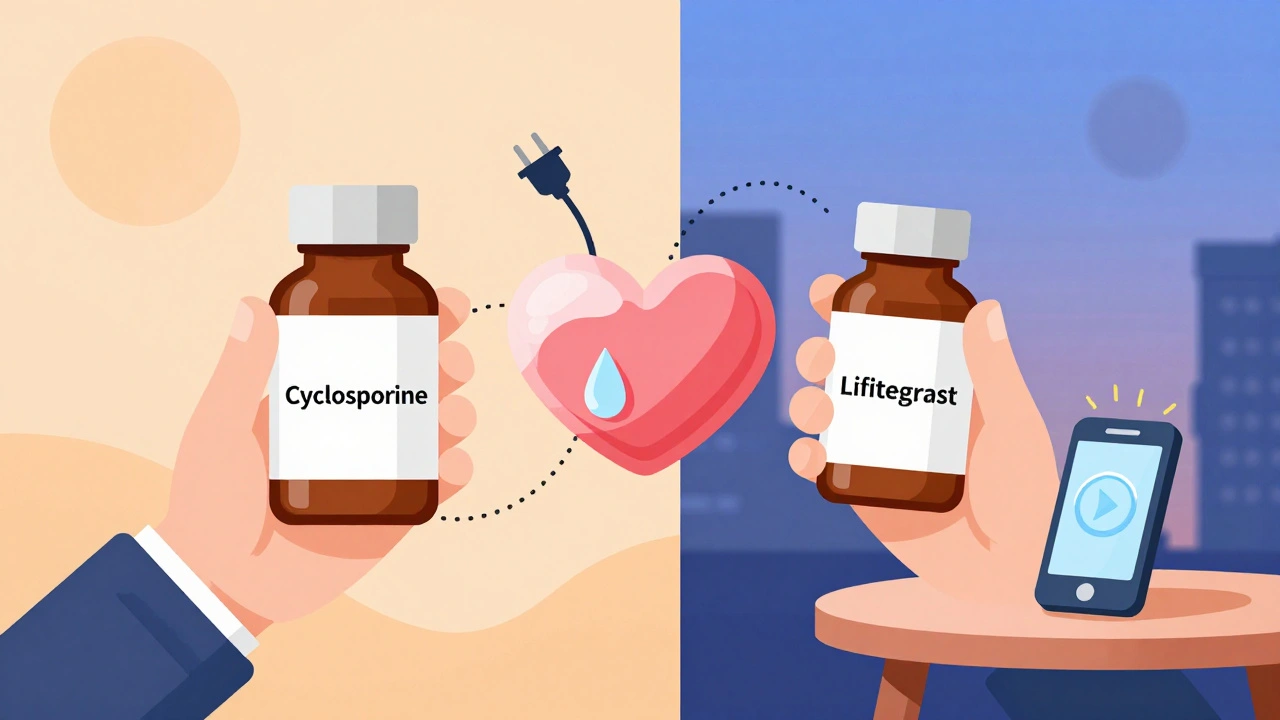
Real Talk: Adherence Is the Biggest Hurdle
Here’s the truth no one talks about: most people stop using these treatments before they work.
Consumer data shows 63% of people stick with cyclosporine for three months. By six months, that drops to 41%. Why? Cost. Discomfort. Waiting too long to see results. Lifitegrast users drop off because of the taste. Plug users get frustrated when they feel discomfort or the plug falls out.
Success isn’t about the best drug. It’s about finding the one you can stick with. If you’re going to use cyclosporine, set a reminder on your phone. Buy the fridge pack. Talk to your doctor about patient assistance programs-78% of commercially insured patients get help covering Restasis.
If you try lifitegrast and hate the taste, don’t give up. Just change the time. Use it before bed. Let your body adjust.
And if you’re considering plugs? Ask for a collagen trial first. See if blocking your ducts helps before committing to something permanent.
There’s no magic bullet. But there is a path. You just have to pick the one that fits your life.
How long does it take for cyclosporine to work for dry eye?
Most people start seeing improvement in tear production and corneal health after 3 to 6 months of consistent twice-daily use. Some notice early signs of reduced inflammation within 4 weeks, but full benefits take time. Stopping early is the most common reason it seems ineffective.
Does lifitegrast really cause a metallic taste?
Yes. About 42% of users report a metallic or bitter taste shortly after using Xiidra. It’s not dangerous, but it’s unpleasant. The best way to manage it is to apply the drops at night before bed. The taste usually fades by morning, and many users adapt over time.
Are punctal plugs safe and permanent?
Collagen plugs are temporary and dissolve naturally in 3 to 10 days. Silicone plugs are designed to be permanent but can be removed by a doctor if needed. About 23% of temporary plugs fall out within two weeks, and 15-20% of silicone plugs may extrude or cause irritation over time. They’re considered safe when inserted properly by a trained professional.
Can I use cyclosporine and lifitegrast together?
Doctors rarely recommend using both at the same time. They work on similar inflammatory pathways, so combining them doesn’t usually offer extra benefit-and increases side effects and cost. Most patients try one, then switch to the other if needed. Plugs are often added alongside either medication, not both.
What’s the difference between Restasis and Cequa?
Both contain cyclosporine, but Cequa uses nanomicellar technology to deliver 0.1% cyclosporine-double the concentration of Restasis (0.05%). Studies show Cequa may improve absorption and reduce the burning sensation for some users. However, it’s more expensive and not always covered by insurance. Restasis MultiDose is the only version with a multi-dose bottle; generics are only available for the single-use vials.
Do dry eye treatments cure the condition?
No. Dry eye is a chronic condition, like high blood pressure. These treatments manage symptoms and slow progression, but they don’t cure it. Most people need ongoing care-whether it’s daily drops, occasional plugs, or a combination. The goal is to reduce discomfort and protect your vision long-term.
What to Do Next
If you’ve been using artificial tears for months and still feel like your eyes are on fire, it’s time to talk to your eye doctor. Bring a list of what you’ve tried, how often you use drops, and what symptoms bother you most. Ask about cyclosporine, lifitegrast, or plugs. Don’t assume one is better than the other-ask which makes sense for your case.
Take notes during the visit. Write down side effects, costs, and how often you need to use the treatment. If you’re unsure, get a second opinion. Dry eye isn’t one-size-fits-all. The right treatment is the one you can live with-for months, not just days.


Post A Comment