
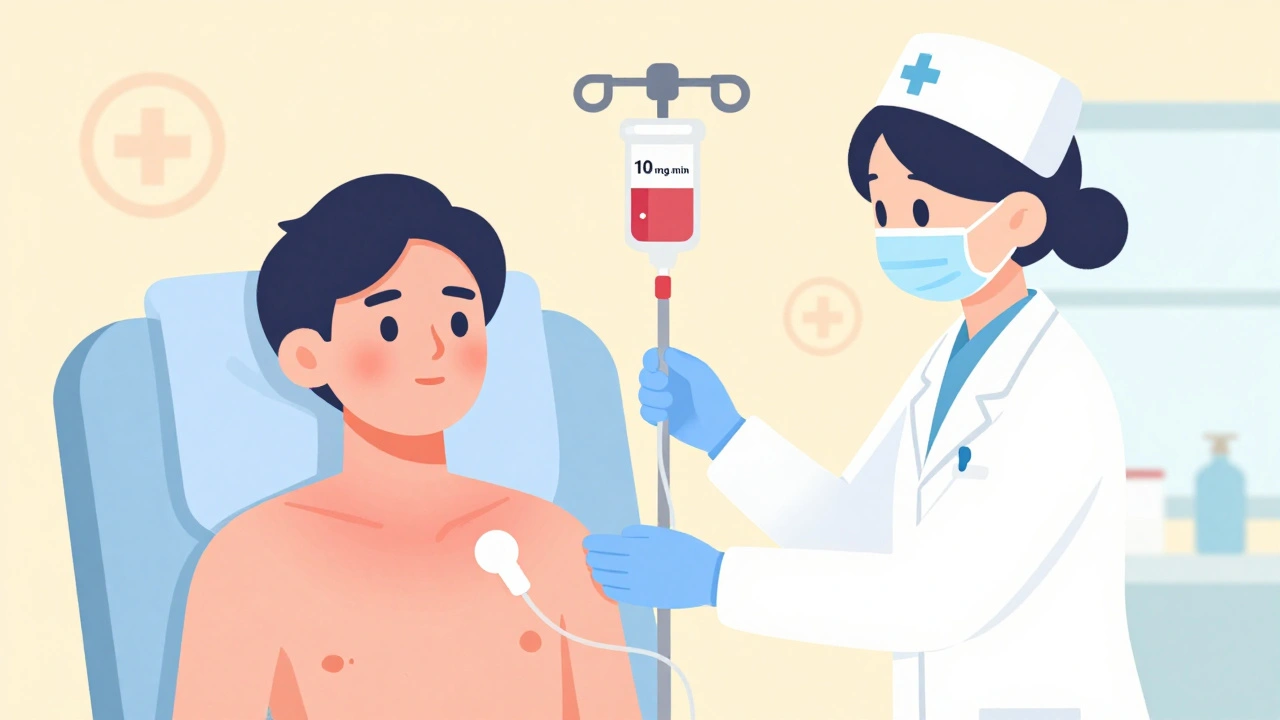
Vancomycin Infusion Rate Calculator
For doses less than 500mg, infuse over at least 60 minutes. For 1-2 grams, infuse over 60-120 minutes as appropriate for the dose.
Infusion Rate Information
Safe Infusion Rate: 10 mg/min or slower
Maximum Infusion Rate: 10 mg/min
Vancomycin is a powerful antibiotic used to treat serious bacterial infections like MRSA and severe intestinal infections. But for many patients, getting this drug isn’t as simple as a quick IV push. A common and unsettling reaction can happen during infusion - one that causes flushing, itching, and sometimes even a drop in blood pressure. For decades, this reaction was called red man syndrome. Today, medical professionals are moving away from that term. The more accurate, respectful, and clinically useful name is vancomycin infusion reaction - or sometimes, vancomycin flushing syndrome.
What Actually Happens During a Vancomycin Infusion Reaction?
This isn’t a true allergy. You don’t need to have been exposed to vancomycin before for it to happen. It doesn’t involve IgE antibodies like anaphylaxis does. Instead, vancomycin directly triggers mast cells and basophils in your body to dump histamine - the same chemical that causes hives and runny noses during allergies. This flood of histamine leads to the classic symptoms: redness and warmth on the face, neck, chest, and upper back; intense itching; and sometimes a drop in blood pressure or a fast heartbeat.
The timing is predictable. Symptoms usually start 15 to 45 minutes after the infusion begins. In some cases, they can show up as early as 4 minutes after starting, or just after the infusion ends. The good news? Once you stop the drip, symptoms typically fade within 30 minutes.
It’s important to know this isn’t just a skin issue. In rare, severe cases, people can feel chest tightness, muscle spasms, or even trouble breathing. These signs need immediate attention - but they’re still not the same as anaphylaxis. True anaphylaxis from vancomycin is extremely rare. A 2022 UCSF study found that out of 198 patients labeled as allergic to vancomycin, only 3% had real anaphylaxis. The vast majority - over 90% - had this infusion reaction, which is completely different.
Why the Term ‘Red Man Syndrome’ Is Outdated - and Harmful
The name ‘red man syndrome’ was coined in the 1970s based on how patients looked during the reaction. But it’s not just outdated - it’s offensive. The term implies a racial stereotype, and medical institutions are actively removing it from records and guidelines. A 2021 study in Hospital Pediatrics reviewed over 21,000 allergy records and found that 61.6% of vancomycin-related allergy notes still used the term ‘red man syndrome.’ After a hospital-wide push to replace it with ‘vancomycin flushing syndrome,’ that number dropped to 44.6% in just three months.
Major organizations like the Infectious Diseases Society of America and the American Academy of Allergy, Asthma & Immunology now officially recommend using ‘vancomycin infusion reaction’ in all clinical documentation. Harvard’s FXB Center for Health and Human Rights calls such terms ‘reinforcements of harmful stereotypes’ that contribute to real health disparities. Changing the name isn’t just about politeness - it’s about accurate, respectful, and inclusive care.
What Makes the Reaction Worse? Dose and Speed
This reaction is all about how fast you give the drug. Vancomycin is not meant to be pushed quickly. Giving it too fast - especially over 10 mg per minute - dramatically increases the risk. A landmark 1988 study in the Journal of Infectious Diseases showed that when 1,000 mg was given over one hour (about 16.7 mg/min), 9 out of 11 healthy adults had a reaction. When the same dose was given over 2 hours (5 mg/min), none did.
Today, the standard is clear: vancomycin should be infused over at least 60 minutes for a 1-gram dose. For larger doses (like 1.5 or 2 grams), extend the time to 90-120 minutes. Slowing the infusion cuts the reaction rate by more than 90%. That’s not a suggestion - it’s standard of care.
Even more surprising? The reaction often gets less severe with repeated doses. The same 1988 study found that when patients got a second 1,000 mg dose, their symptoms were milder. This suggests the body may develop a kind of tolerance - a phenomenon called tachyphylaxis. That’s why patients who’ve had a reaction before can often safely receive vancomycin again, as long as the infusion is slowed down.
How to Prevent and Manage the Reaction
Prevention is simple and effective. Slow the infusion. That’s it. There’s no need to pre-medicate patients who’ve never had a reaction before. A 2018 study in the Journal of Hospital Medicine found no benefit in routinely giving antihistamines like diphenhydramine to first-time users. It adds cost, risk, and confusion - without improving outcomes.
But if you’ve had a reaction before, or you need to give the drug faster for clinical reasons, then pre-medication helps. Giving diphenhydramine (25-50 mg IV) and ranitidine (50 mg IV) 30-60 minutes before the infusion can block the histamine response. Some hospitals also use other antihistamines like cetirizine or famotidine. But these are for patients with a history - not everyone.
If a reaction happens during infusion, stop the drip immediately. Monitor blood pressure and heart rate. Most patients just need to wait. Symptoms will fade on their own. If hypotension is present, fluids and sometimes epinephrine may be needed - but that’s rare. Never label someone as ‘allergic to vancomycin’ just because they had this reaction. It’s not an allergy. It’s a pharmacological reaction you can control with infusion speed.
Other Drugs That Can Cause Similar Reactions
Vancomycin isn’t alone. Several other antibiotics and drugs can trigger histamine release the same way. Amphotericin B, used for fungal infections, causes a similar flushing reaction - but through a different mechanism, involving the complement system. Rifampicin, another antibiotic, can cause hypersensitivity by forming reactive metabolites that bind to proteins in the body. Even ciprofloxacin, a common fluoroquinolone, has been linked to flushing in some patients.
That’s why it’s important to look at the whole picture. If a patient gets flushed after a new drug, don’t assume it’s vancomycin. Check what else they got. Also avoid giving vancomycin at the same time as other histamine-releasing agents like opioids or muscle relaxants. These can make the reaction worse.

When to Consider Alternatives
Most patients can safely receive vancomycin if it’s given slowly. But if someone has had multiple severe reactions despite proper infusion rates, or if they can’t tolerate the long infusion time, alternatives exist. Linezolid, daptomycin, and teicoplanin are options for certain infections. Desensitization protocols - where the drug is given in tiny, gradually increasing doses under close monitoring - are also possible in hospital settings for patients with no other options.
But these are last-resort steps. The vast majority of cases are prevented with one simple change: slow the drip.
What Patients Should Know
If you’re about to get vancomycin, here’s what you need to remember:
- This reaction is common, but not dangerous for most people.
- It’s not an allergy - you won’t die from it.
- The medical team should be infusing it slowly - over at least one hour for a standard dose.
- If you feel warm, flushed, or itchy during the drip, tell the nurse right away.
- Don’t assume you’re allergic because you had this reaction before. Ask for clarification: ‘Was this vancomycin infusion reaction?’
- Never let a provider label you ‘allergic to vancomycin’ unless they’ve confirmed a true IgE-mediated reaction - which is extremely rare.
Vancomycin saves lives. But it’s not a drug to rush. When given correctly, it’s safe and effective. When given too fast, it causes a reaction that’s uncomfortable - but easily avoided. The key isn’t more drugs. It’s more time.
Is vancomycin flushing syndrome an allergic reaction?
No, vancomycin flushing syndrome is not an allergic reaction. It’s an anaphylactoid reaction caused by direct histamine release from mast cells. Unlike true allergies, it doesn’t involve IgE antibodies and can happen the first time you receive vancomycin. It’s a pharmacological effect, not an immune response.
Can vancomycin cause anaphylaxis?
True anaphylaxis from vancomycin is very rare - occurring in only about 3% of patients labeled as ‘allergic’ to it. Most reactions are infusion-related flushing, not IgE-mediated anaphylaxis. Signs of true anaphylaxis include wheezing, throat swelling, low blood pressure, and loss of consciousness - which are not typical of vancomycin flushing syndrome.
How fast can vancomycin be safely infused?
Vancomycin should be infused at a rate of no more than 10 mg per minute. For a standard 1-gram dose, that means a minimum infusion time of 60 minutes. For larger doses (1.5-2 grams), extend the time to 90-120 minutes. Faster infusions significantly increase the risk of flushing, itching, and hypotension.
Should I get antihistamines before vancomycin?
Only if you’ve had a previous vancomycin infusion reaction. Routine pre-medication with diphenhydramine or ranitidine is not recommended for first-time users. Slowing the infusion rate is far more effective and avoids unnecessary medication. Pre-medication is reserved for patients who need faster infusions despite prior reactions.
Why is ‘red man syndrome’ no longer used?
The term ‘red man syndrome’ is considered offensive and racially insensitive because it implies a stereotype based on skin color. Major medical institutions, including the Infectious Diseases Society of America and UCSF, now use ‘vancomycin infusion reaction’ or ‘vancomycin flushing syndrome’ instead. This change supports inclusive, respectful patient care and reduces stigma in medical records.
Can I get vancomycin again if I had a reaction before?
Yes, most patients can safely receive vancomycin again if it’s given slowly - at or below 10 mg per minute. Many experience milder reactions on subsequent doses due to tachyphylaxis. Never assume you’re allergic. Always clarify with your provider that the reaction was infusion-related, not a true allergy.
What are signs of a severe vancomycin reaction?
Severe reactions include significant hypotension, chest or back pain, muscle spasms, or difficulty breathing. These are uncommon. If they occur, the infusion must be stopped immediately. Most reactions are mild - flushing and itching - and resolve quickly after stopping the drip. Severe cases require medical support but rarely need epinephrine.


Post A Comment