

Waiting for a kidney transplant isn’t just about hoping for a call. It’s a long, detailed process that starts long before you’re added to the waitlist. If you’re preparing for a transplant, you need to understand the steps, what’s required of you, and how to avoid common pitfalls that delay or even block your listing. The good news? Knowing what to expect gives you control. And control means better outcomes.
How the Evaluation Process Actually Works
Your journey begins when your nephrologist says your kidney function has dropped below an eGFR of 20. That’s the trigger. But getting evaluated doesn’t mean you’re automatically approved. Every transplant center follows strict national standards set by the Organ Procurement and Transplantation Network (OPTN). They’re not just checking if you’re sick enough-they’re checking if you’re strong enough to survive surgery and live with a new organ for years. The evaluation isn’t one appointment. It’s 15 to 25 visits over 8 to 16 weeks. You’ll meet with a transplant coordinator who becomes your main point of contact. They’ll schedule blood tests, imaging, consultations, and screenings. You’ll need to bring five years of medical records, including dialysis logs if you’ve had them. Missing one appointment can delay everything by weeks. You’ll undergo a full medical workup: blood type, liver and kidney function tests, viral screenings for HIV and hepatitis (using CDC-recommended tests), heart checks like an echocardiogram and stress test, and cancer screenings based on your age and gender. For men over 50, that means PSA testing. Women need mammograms and Pap smears. Labs must show specific values: hemoglobin above 10 g/dL, platelets over 100,000/μL, albumin above 3.5 g/dL. If you’re overweight-BMI over 40-you’ll be asked to lose weight before moving forward.Why Psychosocial Evaluation Matters More Than You Think
Medical tests are only half the story. The other half is the psychosocial evaluation. This isn’t about being "mentally stable" in a vague way. It’s about proving you can handle life after transplant. You’ll talk to a social worker and a psychologist. They’ll ask: Who will drive you to appointments? Can you afford $3,500 in co-pays for the first year? Do you understand you’ll take immunosuppressants every single day for the rest of your life? These questions aren’t optional. In fact, psychosocial issues cause 32% of evaluation failures-more than medical problems. People get turned down for things like inconsistent medication history, no transportation plan, or lack of financial support. One patient on Reddit spent 11 weeks and 17 appointments just to finish evaluation. Another spent $8,200 out-of-pocket despite having insurance. It’s exhausting. But if you show you’ve thought this through, you move faster.Insurance and Financial Readiness
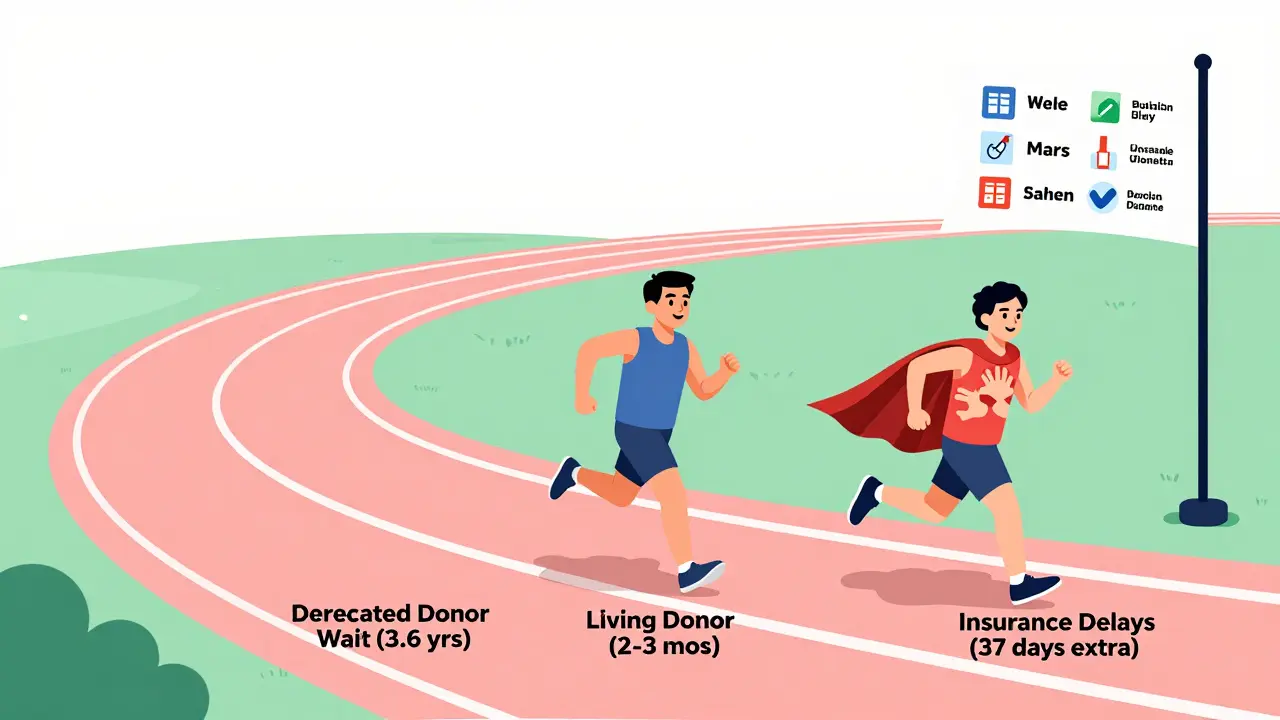
Medicare covers 80% of transplant costs under Part B and drugs under Part D. Private insurers usually cover 70-90%, but you still need to meet your deductible-averaging $4,550 a year. Medicaid patients face longer delays: 37 days longer on average than those with private insurance. And 28.7% of all evaluation delays come from insurance issues. Transplant centers won’t list you until they have written proof your insurance will cover the transplant and follow-up care. That means calling your insurer yourself. Don’t wait for your doctor to do it. Ask for a letter of coverage. If they deny a test, appeal immediately. Medicaid patients are especially vulnerable-24.1% face denials for key tests. If you’re struggling, contact the American Kidney Fund. They help with copays and evaluation costs.Getting on the Waitlist: What Happens After Evaluation
Once all tests are done, your case goes to the transplant selection committee. This group includes a surgeon, nephrologist, social worker, psychiatrist, and coordinator. They meet weekly. You’ll get a decision within 72 hours. If approved, you’re added to the national waitlist. As of January 2024, over 102,000 people are waiting for a kidney. The average wait time? 3.6 years. But your wait isn’t just about time-it’s about compatibility. Your blood type, tissue match, and how sensitized your immune system is (measured by cPRA) determine how fast you get a match. Highly sensitized patients (cPRA ≥98%) now get priority under the 2024 OPTN update.
Living Donors: The Fastest Path to a Transplant
About 40% of kidney transplants in 2023 came from living donors. Why? Because they’re faster, better matched, and have higher success rates. A kidney from a living donor lasts longer-on average 15-20 years versus 10-15 for a deceased donor kidney. And the one-year graft survival rate? 96.3% for living donor transplants versus 94.1% for deceased. Finding a living donor isn’t easy. But if someone offers, the process is streamlined. At top centers, donor evaluation now takes just 2-3 weeks thanks to rapid crossmatch protocols. The donor needs the same medical checks: blood type, kidney function, heart tests, cancer screening. But they also need to be free of coercion. No one should feel pressured. If they’re not a match, programs like Kidney Paired Donation can swap donors between incompatible pairs. In 2023, that program helped 1,872 people get kidneys.What Gets You Rejected
Not everyone makes it to the waitlist. The top five medical reasons for rejection are:- Active cancer (14.2%)
- Severe heart disease (11.8%)
- Uncontrolled infection (9.3%)
- Severe obesity (BMI >40, 8.7%)
- History of non-adherence (7.9%)
How to Speed Up Your Evaluation
You can’t control the waitlist. But you can control how fast you get on it.- Start early. If your eGFR is below 30, ask your nephrologist for a referral-even if you’re not on dialysis yet.
- Complete your evaluation within 90 days. Patients who do this have an 11.3% higher chance of surviving five years post-transplant.
- Use your patient portal. Track every test result. Don’t wait for a call.
- Bring the same support person to every appointment. They’ll remember things you miss.
- Call your insurance weekly if you’re stuck. Don’t assume they’re working on it.
- Ask about rapid donor evaluation if someone offers to donate.
Racial Disparities and How Centers Are Fixing Them
Black patients wait longer. On average, 28.4% longer than white patients. That gap exists because of systemic delays in referrals, testing access, and insurance coverage. But centers using standardized pathways have cut that gap to 12.1%. Ask your center: Do you use a checklist to ensure every patient gets the same tests at the same pace? If not, push for it.What’s Changing in 2026
New rules are coming. The End-Stage Renal Disease Transplant Act will offer more financial help by 2026, aiming to reduce abandonment rates by 15-20%. HIV-positive patients can now receive kidneys from other HIV-positive donors-217 such transplants happened in 2023, up from zero in 2013. And centers are struggling with staff shortages-63% report not enough coordinators. That means wait times could get longer unless you take charge of your own process.Final Reality Check
This isn’t a quick fix. It’s a marathon. You’ll face stress, paperwork, insurance battles, and emotional fatigue. But if you treat it like a job-with schedules, reminders, and follow-ups-you’ll get through it. The goal isn’t just to survive. It’s to thrive with a new kidney. And that starts with doing the work before you ever get the call.Can I be evaluated for a transplant if I’m on dialysis?
Yes. In fact, most patients start evaluation while on dialysis. Waiting until you’re sicker doesn’t help. Starting early improves your chances of getting a transplant before you need emergency dialysis. Many transplant centers recommend evaluation when eGFR drops below 20-even if you’re not yet on dialysis.
How long does it take to get a kidney from a living donor?
If you have a willing living donor, the entire process-from donor evaluation to transplant-can take as little as 2 to 3 months at top centers. That’s much faster than waiting for a deceased donor, which averages 3.6 years. Donor testing is now streamlined with rapid crossmatch protocols, making it quicker and safer than ever.
What if I can’t afford transplant medications after surgery?
Medication costs average $32,000 per year. Most centers require proof you can cover this before listing. If you can’t, contact the American Kidney Fund or National Kidney Foundation-they offer grants for immunosuppressants. Medicare Part D covers some, but you’ll still need help with co-pays. Don’t wait until after transplant to figure this out.
Can I be removed from the waitlist?
Yes. If you develop a new cancer, uncontrolled infection, or stop taking your medications, you can be removed. Some centers also remove patients who miss follow-up appointments or fail to update their contact info. Stay in touch with your coordinator. If your health changes, tell them immediately. You can always be relisted if your condition improves.
Do I need to be a U.S. citizen to get a kidney transplant?
No. Citizenship is not required. Legal residents with documented status can be evaluated and listed. Transplant centers cannot deny care based on immigration status. However, you must still prove you can afford long-term care and medications. Some states offer coverage to undocumented residents-check with your local transplant center for options.
What if my living donor changes their mind?
It happens. Donors can back out at any point-even after testing is complete. That’s why it’s important to have a backup plan. If your donor withdraws, your transplant team will help you return to the deceased donor waitlist. Some centers also help you find another potential donor through paired exchange programs. Don’t feel guilty if your donor changes their mind. It’s a huge decision, and their safety comes first.


Post A Comment