
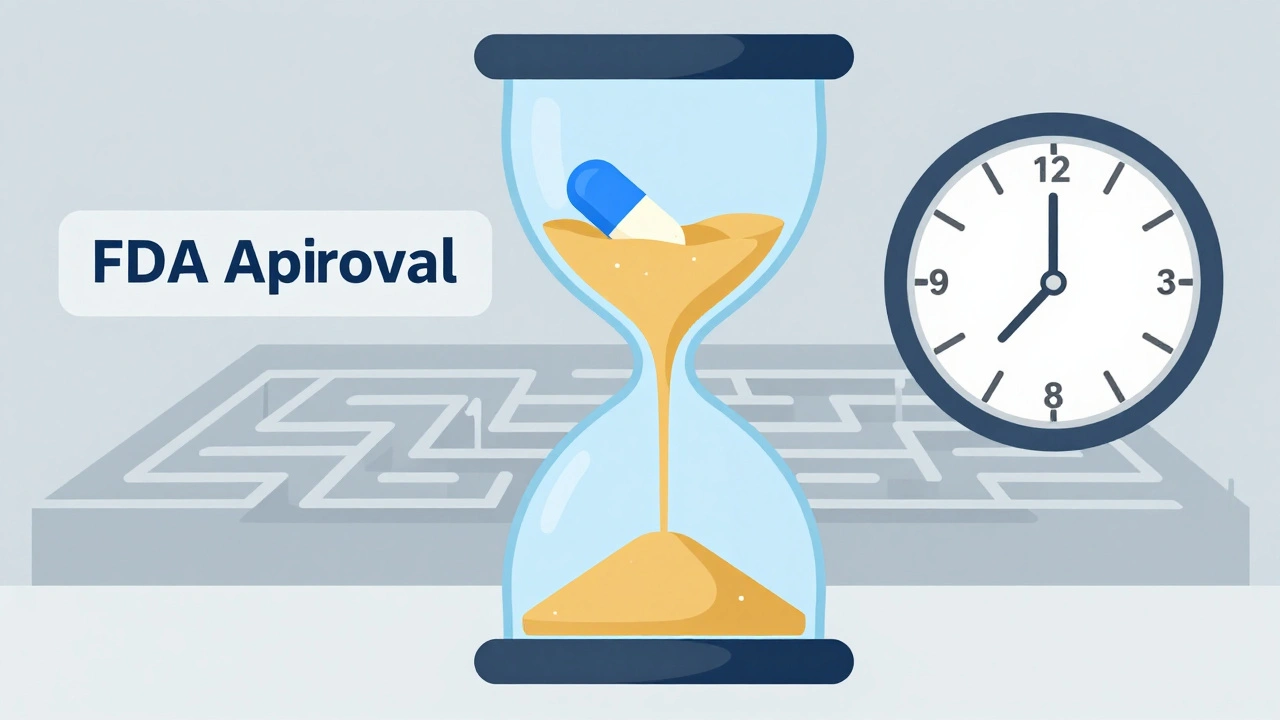
When a pharmaceutical company spends 12 years and over $2 billion developing a new drug, only to find out that half of its 20-year patent clock has already ticked away before the FDA even approves it, something’s off. That’s where patent term restoration comes in. It’s not a loophole. It’s not a gift. It’s a legal fix for a broken timeline - and it’s why your favorite brand-name drug stays expensive long after it should’ve gone generic.
Why Drug Patents Need Extra Time
A patent gives you 20 years of exclusive rights from the day you file it. Sounds fair, right? But here’s the catch: you can’t sell your drug until the FDA says it’s safe and effective. And that process? It takes 8 to 12 years on average. That means by the time your drug hits the market, you’ve already lost nearly half your monopoly time. Without patent term restoration, companies would have just 6-8 years to recoup billions in R&D costs before generics crush their profits.The Hatch-Waxman Act of 1984 fixed this. It didn’t create a new patent. It didn’t extend the patent’s original term. It simply gave back the time lost waiting for regulators. This wasn’t charity - it was economics. If drug makers couldn’t recover lost patent time, they’d stop investing in new treatments. The system was designed to balance two goals: reward innovation and let generics in eventually.
How Patent Term Restoration Actually Works
The math behind patent term restoration isn’t simple, but the idea is. The formula looks like this:PTE = Regulatory Review Period − Pre-Grant Review Period − Days of Applicant’s Lack of Due Diligence − ½(Total Patent Term − Pre-Grant Total Patent Term)
Let’s break that down in plain terms:
- Regulatory Review Period (RRP): The total time from when you submit your application to the FDA until they approve your drug.
- Pre-Grant Review Period (PGRRP): The time between filing your patent and getting it granted. This doesn’t count toward extension - you’re supposed to file patents early, so the clock starts ticking before approval.
- Due Diligence: If you sat on your application for months, or missed deadlines, those days get deducted. The FDA requires day-by-day proof you were moving forward - emails, lab logs, submission receipts.
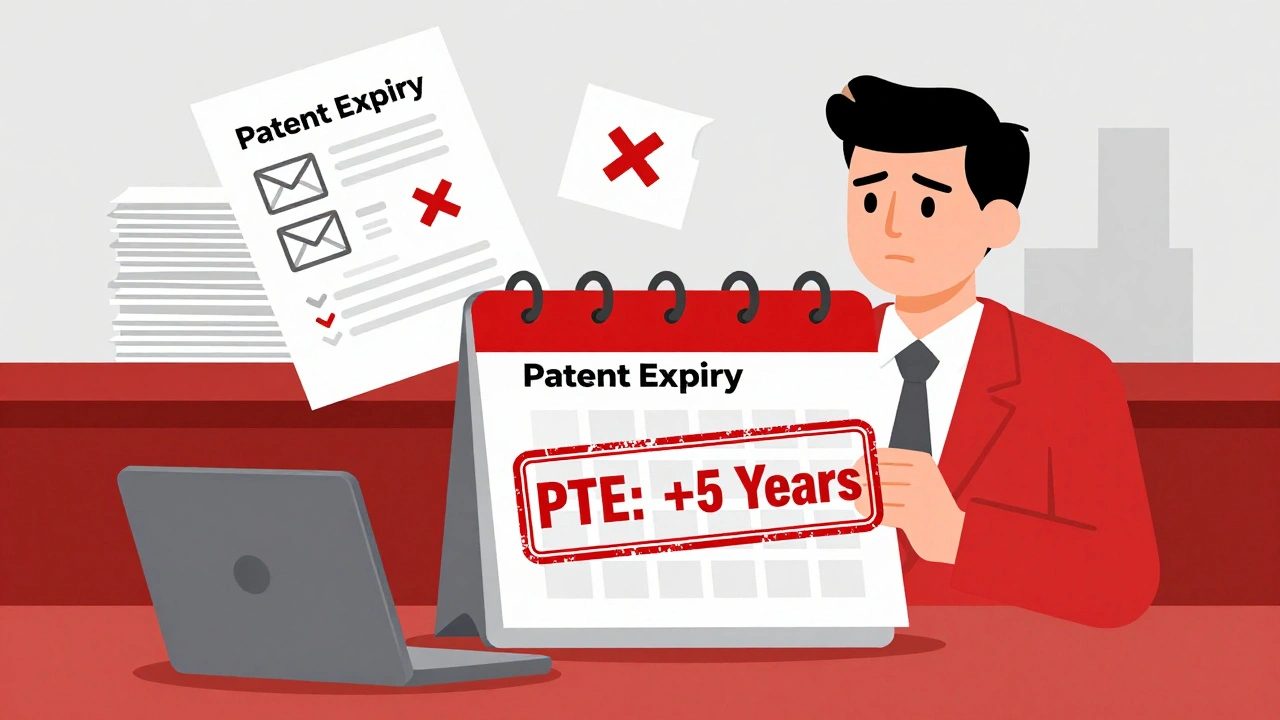
- The 14-year cap: Even if you lost 10 years to approval, you can’t get more than 5 years back. And your total patent life - original + extension - can’t go past 14 years after FDA approval.
So if your drug took 9 years to get approved, and you were fully diligent the whole time, you’d get 5 years back - the max. If you took 11 years, you still only get 5. If you took 6 years and missed 2 months of due diligence, you get 4 years and 10 months.
Who Gets It - And Who Doesn’t
Not every patent qualifies. Only patents covering:- Human drugs
- Medical devices
- Food additives
- Color additives
- Animal drugs (added in 1988)
You also can’t apply if:
- The patent already expired
- You already got a PTE for this product before
- You didn’t submit your application within 60 days of FDA approval
And here’s the kicker: only one patent per product can get extended. That’s why big pharma files dozens of patents - one for the active ingredient, another for the pill coating, another for the delivery method. Only one gets the extension. The rest? They’re just there to block generics later.

The Hidden Strategy Behind PTE
Most people think patent term restoration is about protecting the original invention. But data from the FDA’s Orange Book shows 78% of PTE applications in recent years are tied to secondary patents - not the original compound patent. That’s not accidental. It’s a tactic.Imagine you patent a cholesterol drug in 2010. You get approval in 2018. You file for PTE and get 5 extra years. Your patent now expires in 2023. But in 2015, you also patented a new tablet form that releases the drug slower. You file for PTE on that one too. Now you’ve got two patents - one covering the molecule, one covering the delivery. Only one gets extended. But if you pick the right one, you can delay generics even longer.
That’s why 91% of drugs that get PTE still hold market dominance years after the extension ends. They’ve stacked patents like dominoes. When one falls, another’s already lined up.
Why PTE Applications Get Denied
The USPTO denies about 12.7% of PTE applications. The biggest reason? Poor documentation.Pharmaceutical companies think submitting FDA approval letters is enough. It’s not. The FDA wants:
- Every submission date to the FDA
- Every reply from the agency
- Lab logs showing continuous testing
- Meeting minutes with regulatory teams
- Proof you didn’t delay - even by a single day
A senior patent attorney on Reddit shared that the most common mistake is treating PTE like a formality. “We’ve seen teams wait until the last week to gather documents. By then, emails are gone, logs are lost, and the FDA says, ‘You weren’t diligent.’”
There’s also a technical trap: the 60-day deadline. If your drug gets approved on June 1, you have until July 31 to file. Miss it by a day? No extension. No exceptions. No appeals.
Interim Extensions: The Safety Net
What if your drug is still under review when your patent expires? You can’t just wait. That’s where interim extensions come in.You can apply for a temporary extension if you file between 6 months before your patent expires and 15 days before it runs out. This keeps your protection alive while the FDA finishes its review. It’s not automatic. You still need to prove due diligence. But it buys time - often crucial for drugs on the verge of approval.
Who’s Winning - And Who’s Losing
The numbers tell a clear story:- Drugs with PTE keep 92% of their market share during the extension period.
- After generics enter, that drops to 37%.
- PTE adds $4.2 billion a year to U.S. drug spending.
- 34% of 2023 PTE applications were for biologics - up from 19% in 2018.
That’s why critics call it a subsidy for big pharma. A 2022 Yale study found that PTE was working exactly as designed - but that’s the problem. Congress meant to restore a few years of lost time. Instead, it became a tool to delay competition for a decade or more.
Meanwhile, generic manufacturers struggle. They’re ready to produce a cheaper version, but they’re stuck waiting for patents to expire - or fighting legal battles over secondary claims. The system was meant to balance innovation and access. Today, it leans hard toward the former.
The Future of Patent Term Restoration
The FDA is pushing to modernize the process. By Q2 2026, they plan to roll out digital submission tools to reduce paperwork and errors. That’s good news - but it won’t fix the core issue.Two major bills are under discussion:
- The Preserve Access to Affordable Generics and Biosimilars Act would ban “evergreening” - filing new patents just to delay generics.
- The GAO-25-802SP review, due in December 2025, will assess whether PTE is driving up drug prices beyond what Congress intended.
For now, PTE remains a powerful, complex, and controversial tool. It’s not going away. But how it’s used - and who benefits - is under growing scrutiny.
What This Means for You
If you’re a patient: PTE is why your insulin or cancer drug still costs $1,000 a month, even though it’s been on the market for 15 years. The original patent expired. But the extension didn’t.If you’re in pharma or biotech: PTE is a make-or-break part of your commercial strategy. Get the documentation right. File on time. Choose the right patent to extend. Mess up, and you lose millions.
If you’re a generic manufacturer: Understand PTE. Track FDA approvals. Watch for interim extensions. Your window to enter the market isn’t just about patent expiry - it’s about whether the company got an extension.
Patent term restoration isn’t about fairness. It’s about timing. And in drug development, timing is everything.
What is the maximum number of years a patent can be extended under PTE?
The maximum extension allowed under Patent Term Restoration is five years. Even if a drug took 10 years to get FDA approval, the law caps the extension at five years. Additionally, the total patent life - original term plus extension - cannot exceed 14 years from the date of FDA approval.
Can a patent get more than one patent term extension?
No. Only one patent per product can receive a patent term extension under the Hatch-Waxman Act. However, companies often file multiple patents on the same drug - for the active ingredient, formulation, delivery method, or use - and choose the one with the most valuable extension. Only one of those gets extended.
What happens if I miss the 60-day deadline to apply for PTE?
If you miss the 60-day window after FDA approval, you lose the chance for an extension permanently. There are no extensions, appeals, or exceptions. This is one of the most common reasons applications are denied - teams underestimate how fast the clock runs after approval.
Does PTE apply to biologics and gene therapies?
Yes. The 21st Century Cures Act of 2016 expanded PTE eligibility to include certain regenerative medicine products, including gene therapies and advanced biologics. In 2023, 34% of all PTE applications were for biologics - up from just 19% in 2018.
How is PTE different from patent term adjustment (PTA)?
PTE compensates for delays caused by the FDA during drug approval. PTA compensates for delays caused by the USPTO during patent examination. They’re two separate systems. A patent can get both - but PTE only applies to FDA-regulated products like drugs and devices. PTA applies to any patent.
Why do so many PTE applications get denied?
The main reason is inadequate proof of due diligence. The FDA requires detailed, day-by-day records showing continuous progress through the regulatory process - not just milestone dates. Missing emails, incomplete lab logs, or unexplained delays can lead to denial. About 12.7% of applications are rejected for this reason.


Post A Comment